B-Sludge
Advanced Sludge
Treatment
B-Sludge is the smart solution for organic sludge treatment, handling everything from diluted streams to dewatered material. Designed to process a wide range of Total Suspended Solids (1% to over 30%), B-Sludge ensures consistent feed conditions for downstream processes, unlocking efficiency and value at every stage.
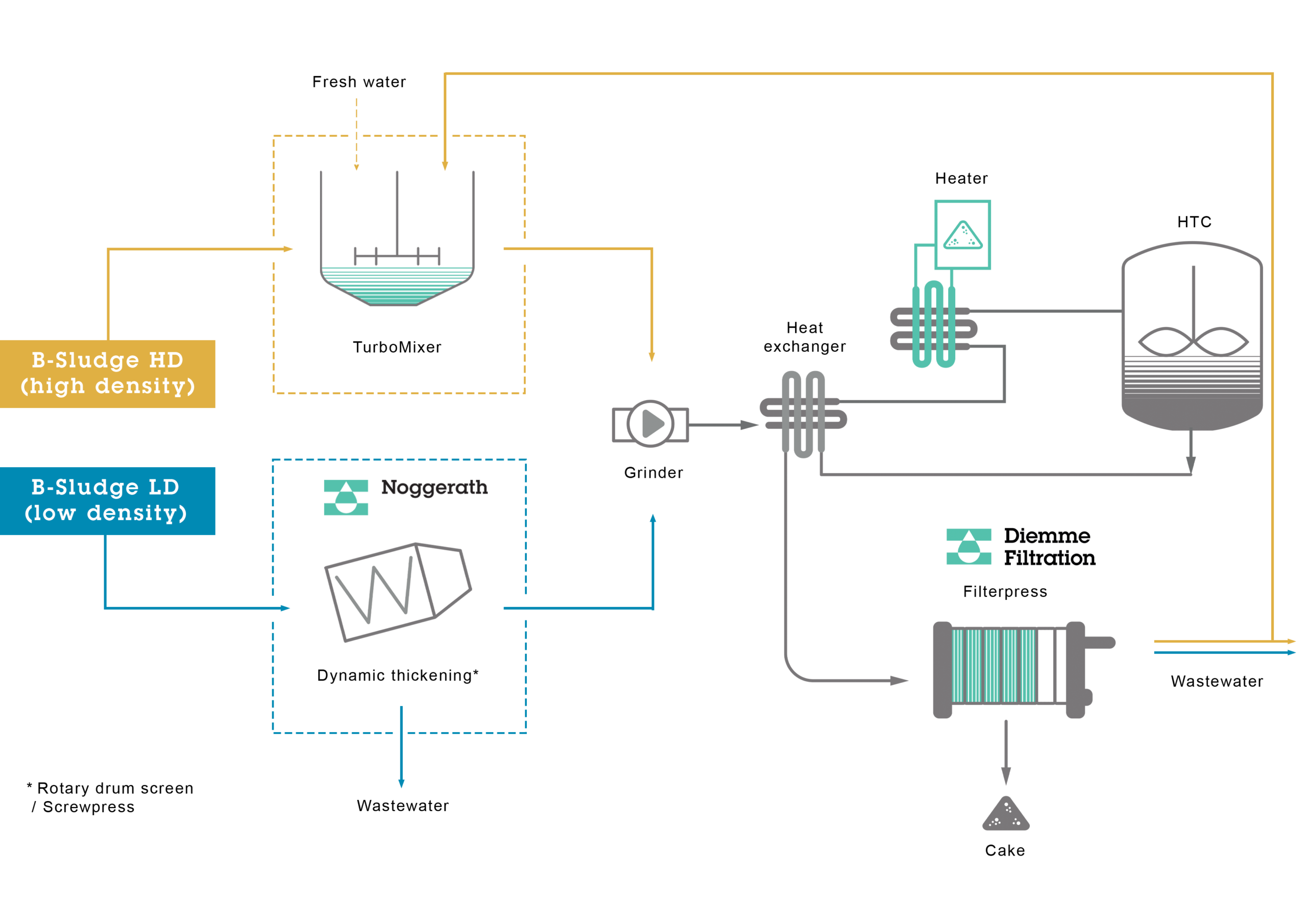
The system combines mechanical pre-treatment, hydrothermal carbonisation (HTC), and polyelectrolyte-free solid-liquid separation, providing an integrated, turnkey solution for modern sludge management.
With B-Sludge, every treatment step works in synergy, reducing environmental impact, lowering operating costs, and turning a traditional waste challenge into a resource opportunity.
CHARACTERISATION AND PRE-TREATMENTS
HTC: TURNING SLUDGE INTO A RESOURCE
Hydrothermal Carbonisation (HTC) is a central stage of the B-Sludge process, designed to upgrade sewage sludge and unlock new value from waste. This thermochemical treatment, carried out at 180-200°C under autogenous pressure, transforms sludge into hydrochar, a carbon-rich biomass with high energy content.
Using a series of sequential reactors in an alternating batch configuration, HTC enables continuous, efficient treatment, while a dedicated heat exchanger optimises energy use, making the process both sustainable and cost-effective.
SOLID-LIQUID SEPARATION
After HTC treatment, the sludge undergoes solid-liquid separation through a filter press, with no need for polyelectrolytes. HTC modifies the sludge’s rheological properties, making solids easier to separate and improving overall process efficiency.
This stage is critical for B-Sludge, enabling substantial volume reduction while recovering valuable resources from both solid and liquid fractions.
Integrated, Sustainable, Smart
B-Sludge is more than a single technology: it’s a complete system where characterisation, pre-treatment, HTC, and solid–liquid separation work together.
Every stage is designed to enhance the next, delivering:
- Improved operational efficiency
- Lower environmental impact
- Reduced costs
- New opportunities to recover value from sludge
Turn sludge from a challenge into a strategic resource with B-Sludge.